Coastal taipan entry from Australia, the venom in a Taipan is strong enough to kill up to 12,000 guinea pigs. The venom clots the victim’s blood, blocking arteries or veins. It is also highly neurotoxic. Before the advent of an antivenin, there are no known survivors of a Taipan bite, and death typically occurs within an hour. Even with successful administration of antivenin, most victims will have an extensive stay in intensive care. It has been likened to the African Black Mamba in morphology, ecology and behavior.
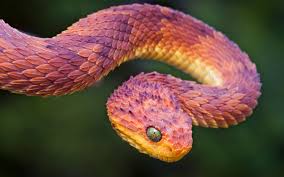
Saw-Scaled-Viper Vipers are found throughout most of the world, but arguably the most venomous is the Saw Scaled Viper and the Chain Viper, found primarily in the Middle East and Central Asia, particularly India, China and South East Asia. Vipers are quick tempered and generally nocturnal, often active after rains. They are also very fast. Most of these species have venom that cause symptoms that begin with pain at the site of the bite, immediately followed by swelling of the affected extremity. Bleeding is a common symptom, especially from the gums. There is a drop in blood pressure and the heart rate falls. Blistering occurs at the site of the bite, developing along the affected limb in severe cases. Necrosis is usually superficial and limited to the muscles near the bite, but may be severe in extreme cases. Vomiting and facial swelling occurs in about one-third of all cases. Severe pain may last for 2-4 weeks. Often, local swelling peaks within 48-72 hours, involving the affected limb. Discoloration may occur throughout the swollen area as red blood cells and plasma leak into muscle tissue. Death from septicaemia, respiratory or cardiac failure may occur 1 to 14 days post-bite, or even later.
Tiger Snake are found in Australia, the Tiger snake has a very potent neurotoxic venom. Death from a bite can occur within 30 minutes, but usually takes 6-24 hours. Prior to the development of antivenin, the fatality rate from Tiger snakes was 60-70%. Symptoms can include localized pain in the foot and neck region, tingling, numbness and sweating, followed by a fairly rapid onset of breathing difficulties and paralysis. The Tiger snake will generally flee if encountered, but can become aggressive when cornered. It strikes with unerring accuracy.
The Philippine Cobra is awesome. Drop by drop, its venom is the most deadly of all the Cobra species, and they are capable of spitting it up to 3 metres. The venom is a neurotoxin which affects cardiac and respiratory function, and can cause neurotoxicity, respiratory paralysis and death in thirty minutes. The bite causes only minimal tissue damage. The neurotoxins interrupt the transmission of nerve signals by binding to the neuro-muscular junctions near the muscles. The symptoms might include headache, nausea, vomiting, abdominal pain, diarrhea, dizziness, collapse and convulsions.
The appropriately named Death Adder is found in Australia and New Guinea. They actually hunt and kill other snakes, including some on this list, usually via ambush. Death Adders look quite similar to vipers, in that they have triangular shaped heads and short, squat bodies. They typically inject around 40-100mg of venom with an LD of 0.4mg-0.5mg/kg. An untreated Death Adder bite is one of the most dangerous in the world. The venom is a neurotoxin. A bite causes paralysis and can cause death within 6 hours, due to respiratory failure. Symptoms generally peak within 24-48 hours. Antivenin is very successful in treating a bite from a Death Adder, particularly due to the relatively slow progression of symptoms, the quickest strike in the world, a Death Adder can go from strike position to striking and back again within 0.13 of a second.

The only snake from the Americas on the list, the Rattlesnake is easily identifiable by the tell tale rattle on the end of its tail. They are actually a part of the Pit Viper family, and are capable of striking at up to 2/3rd their body length. It's considered the most venomous species in North America. Surprisingly, juveniles are considered more dangerous than adults, due to their inability to control the amount of venom injected. Most species of rattlesnakes have hemotoxic venom, destroying tissue, degenerating organs and causing coagulopathy (disrupted blood clotting). Some degree of permanent scarring is very likely in the event of a venomous bite, even with prompt, effective treatment, and can lead to the loss of a limb or death. Difficulty breathing, paralysis, drooling and massive hemorrhaging are also common symptoms. Thus, a rattlesnake bite is always a potentially fatal injury. Untreated rattlesnake bites, especially from larger species, are very often fatal. However, antivenin, when applied in time, reduces the death possibility.
Rattle
snake:
The only
snake from the Americas on the list, the Rattlesnake is easily identifiable by
the tell tale rattle on the end of its tail...continue reading
Death Adder sanke:
The
appropriately named Death Adder is found in Australia and New Guinea. They
actually hunt and kill other snakes...continue reading
Viper snake:
Saw-Scaled-Viper
Vipers are found throughout most of the world, but arguably the most venomous
is the Saw Scaled Viper and the Chain Viper, found primarily in the Middle East
and Central Asia, particularly India, China and South East Asia. Vipers are
quick tempered...continue reading
Philippine
Cobra:
the Philippine
Cobra is awesome. Drop by drop, its venom is the most deadly of all the Cobra
species, and they are capable of spitting it up to 3 metres...continue reading
Tiger Snake:
Tiger Snake
are found in Australia, the Tiger snake has a very potent neurotoxic venom...continue reading
Black Mamba:
Blackmamba
is the feared Black Mamba is found throughout many parts of the African
continent. They are known to be highly aggressive, and strike with deadly precision.
They are also the fastest land snake in the world, capable of reaching speeds
of up to 20km/h...continue reading
Taipan snake:
Coastal
taipan entry from Australia, the venom in a Taipan is strong enough to kill up
to 12,000 guinea pigs. The venom clots the victim’s blood, blocking arteries or
veins...continue reading
Blue Krait snake:
The Malayan
or Blue Krait is, by far, the most deadly of this species. Found throughout
South East Asia and Indonesia, 50% of bites from the deadly Blue Krait are
fatal...continue reading
Inland Taipan snake:
The incredible Inland Taipan deserves a spot
of its own. It has the most toxic venom of any land snake in the world. The
maximum yield recorded for one bite is 110mg, enough to kill about 100 humans,
or 250,000 mice...continue reading
Belcher’s
Sea Snake:
Sea Snake is
the most venomous snake known in the world, a few milligrams is strong enough
to kill 1000 people! Less than 1/4 of bites will contain venom...continue raeding


